Much of my life, I've loved the net shaped light patterns that dance off water onto walls, onto the surface below the water, the sand or river bed or onto creatures swimming in the water.
Water spangled, dappled, sparkling, rippling with light.


Such a paradox that the patterns of light, so delicate, playful, entrancing, are named something so awful, caustics. It's because concentrated sunlight can burn and caustic is from the old Greek word, burnt.
From Wikipedia, In optics, a caustic or caustic network is the envelope of light rays reflected or refracted by a curved surface or object, or the projection of that envelope of rays on another surface.The caustic is a curve or surface to which each of the light rays is tangent, defining a boundary of an envelope of rays as a curve of concentrated light. Therefore, in the image to the right, the caustics can be the patches of light or their bright edges. These shapes often have cusp singularities.
 Rippling caustics are commonly formed when light shines through waves on a body of water.
Ah, the poetry of that. An envelope of light rays reflected by a curved surface. Or the projection of an envelope of light rays on another surface. Rippling caustics.
 Okay, so I can barely forgive the caustics name but the definition is so lovely.
Huh. Who knew that the rainbow is itself a caustic?! Scattering of light by raindrops causes different wavelengths of light to be refracted into arcs of differing radius, producing the bow. Another excellent visual of this here.

Apparently, caustics as a mathematical science are used these days a lot in creating computer graphics. As I explored the math of this caustics thing, down the rabbit hole I went. And a delightfully beautiful, poetic, mathematical, scientific rabbit hole it is!
There are caustics used in architecture too, "caustic engineering", producing patterns of light projected off buildings, like this.

Then there are caustics used in photography or film, "raytracing" combined with caustics, as shown here.
Caustics are also created when light passes through glass.

Caustic networks through glass are the kind of thing one's eyes rest on while having a glass of wine with a friend in a restaurant, the pretty play of light and shadow on the tablecloth. I just never knew what to call that before now.
 Caustics are used in designing or constructing glass as well, understanding the play of light when glass is used in any number of ways.


Then I discovered the art created by Philippe Bompas, who has fallen in love with the math and science of caustics and whose works marvelously use the beauty of caustics.

 Then this exquisite creation, the "Aqua Lamp" by two artists at the MadMatter Studio
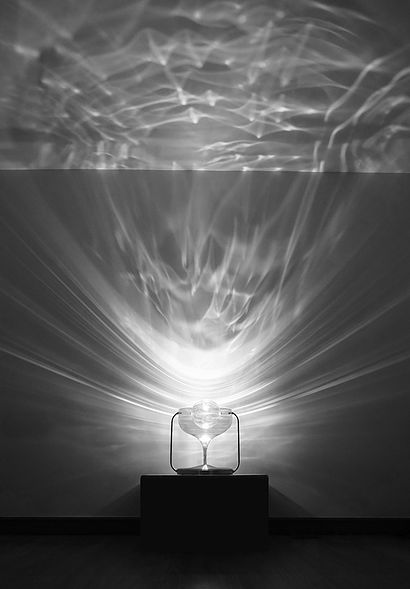
Poetic Lab, a London-based product design company founded by Shikai Tseng and Hansei Chen, created a marvelous work of art, called Ripple, using a lightbulb that mimics the caustic effect of webs of light.


Connected with the math of caustic network plays of light are a few wonderfully named concepts. A cusp singularity. For example, an ordinary cusp occurring as the caustic of light rays in the bottom of a teacup.


Water spangled, dappled, sparkling, rippling with light.
 |
| Photo credit: ImageLib.com Often these patterns can be seen on the surface of swimming pool water or on the walls of the swimming pool itself. Sometimes, sitting in the cabin of a boat, the light patterns play on the walls. So I collected images of these webs of light, as I think of them, and in doing that I came across the mathematical explanation for these beautiful, fluid patterns. |


Such a paradox that the patterns of light, so delicate, playful, entrancing, are named something so awful, caustics. It's because concentrated sunlight can burn and caustic is from the old Greek word, burnt.
From Wikipedia, In optics, a caustic or caustic network is the envelope of light rays reflected or refracted by a curved surface or object, or the projection of that envelope of rays on another surface.The caustic is a curve or surface to which each of the light rays is tangent, defining a boundary of an envelope of rays as a curve of concentrated light. Therefore, in the image to the right, the caustics can be the patches of light or their bright edges. These shapes often have cusp singularities.

Ah, the poetry of that. An envelope of light rays reflected by a curved surface. Or the projection of an envelope of light rays on another surface. Rippling caustics.

Huh. Who knew that the rainbow is itself a caustic?! Scattering of light by raindrops causes different wavelengths of light to be refracted into arcs of differing radius, producing the bow. Another excellent visual of this here.

Apparently, caustics as a mathematical science are used these days a lot in creating computer graphics. As I explored the math of this caustics thing, down the rabbit hole I went. And a delightfully beautiful, poetic, mathematical, scientific rabbit hole it is!
There are caustics used in architecture too, "caustic engineering", producing patterns of light projected off buildings, like this.

Then there are caustics used in photography or film, "raytracing" combined with caustics, as shown here.
Caustics are also created when light passes through glass.


Then I discovered the art created by Philippe Bompas, who has fallen in love with the math and science of caustics and whose works marvelously use the beauty of caustics.
Poetic Lab, a London-based product design company founded by Shikai Tseng and Hansei Chen, created a marvelous work of art, called Ripple, using a lightbulb that mimics the caustic effect of webs of light.

Certain photographers love the caustic effect and are able to capture its beauty remarkably well. I love this image from The Photographer's Guide website (marvelous photographs of their trip to Fez, Morocco).
Mathematicians are working together with artists to find new ways to use and play with this dancing light. Love the beautiful description here: Choreographing light: New algorithm controls light patterns called 'caustics', organizes them into coherent images

See that curved light. That's a cusp.
As I scrolled down the Wikipedia page, in understanding what a cusp is as it's connected with caustic networks of light, I came across the delicious term, a cusp catastrophe. Ha! Had to look that up. Oh, gee, it gets more strangely beautiful, a swallowtail catastrophe, a butterfly catastrophe. The cusps and catastrophes are mathematical names for shapes of patterns, described in more detail here.

This is an example of a swallowtail catastrophe caustic lattice of light. Image taken from Dan Piponi's website page about Caustics and Catastrophes
So, why is it called a catastrophe? Had to dig a little more.
Ah. A lovely, interesting explanation via Vidhya Pushpanathan, here. The word catastrophe comes from Greek tragic drama and refers to the sudden twist of development in the plots. Catastrophe theory is a method for describing the evolution of forms in nature. It is particularly applicable where gradually changing forces produce sudden effects. Its interdisciplinary character was, for people with widely differing agendas, a cultural connector linking mathematics, biology, social sciences and philosophy.
It is represented by using topology. Topology is a generalization of geometry that studies spaces with the degree of generality appropriate to a specific problem. One central concern of topology is to study the properties of spaces that do not change under a continuous transformation, that is, translation, rotation and stretching without tearing.
Apparently, there are seven elementary catastrophes
The fold catastrophe
The cusp catastrophe
Catastrophes in systems with two state variables
The elliptic umbilic
Those catastrophes would each look differently as caustics. As shown on this web page by Samantha Scibelli.
This is an amazing graphic by Johan Hidding. With it I can better see how the light is refracted to create the webs of light in water. Reminds me a bit of those glass marbles.

 |
| Marble by artist Steven Maslach |
And this fabulous visualization of something called the Zel'dovich Lens is a web of light animation that is somehow connected with the expansion of the universe and cosmic web complexity. Wow.
And just to add some wonderful scientific names, the Zeldovich Approximation: Lagrangian & Eulerian Singularity Structure, which has images that show, in part, some of the lattice of light shapes.

All that science and math exploring was discovered just looking for pretty pictures of shimmering webs of light that I love so much. Now I know more about them, that they are called caustic patterns, caustic networks. If one puts the word caustics into Google images, up will come those marvelous nets and spangles of light, those plays of light and shadow, stippled, dappled, webbed, fluid, dancing.
A caustic cat.

And on to some of the images of water and light caustics that I enjoy.